
Emergency Lighting Installation, Testing & Maintenance
BS 5266-compliant emergency lighting systems for commercial, industrial and residential buildings across the UK. Designed, installed, commissioned, tested and maintained by our own engineers. Self-contained LED, central battery, addressable systems, static inverters and specialist installations, all delivered in-house.
Emergency lighting is one of those systems that has to work the one moment you need it. Our job is to make sure it does, and to give you the documentation that proves it.
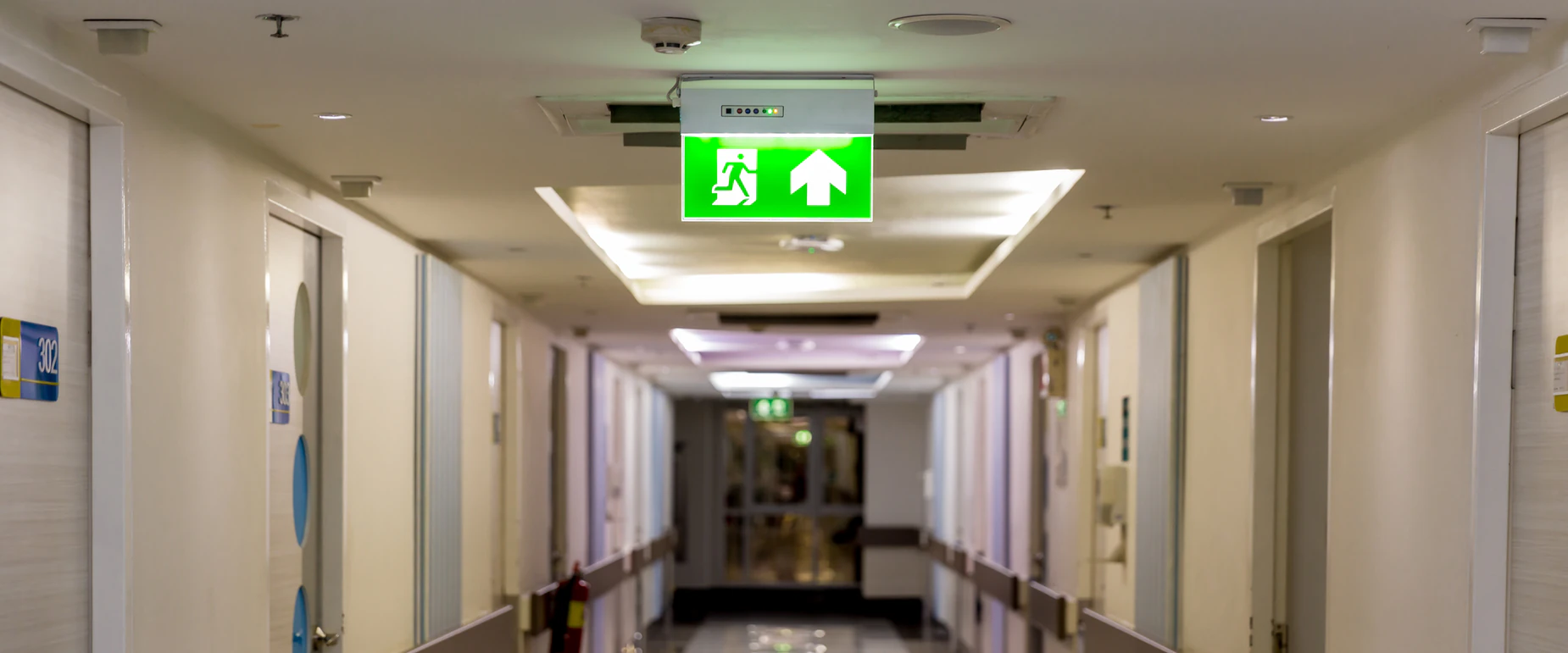
Why emergency lighting matters and what the law requires
Emergency lighting is legally required in almost every non-domestic UK building under the Regulatory Reform (Fire Safety) Order 2005 and supporting building regulations. It exists for one reason: to keep escape routes safely usable when the normal lighting supply fails, whether that’s a power cut, a fire-damaged circuit, or a maintenance fault.
Two things have to be true for an emergency lighting system to actually do its job:
- It has to be designed and installed correctly in the first place, to BS 5266-1, BS EN 1838 and BS EN 50172
- It has to be tested, maintained and certified properly through its working life
WSD handles both ends. The same engineers who design and install your system can take it onto a maintenance contract for routine testing, the annual 3-hour full discharge test, and full BS 5266 compliance documentation.
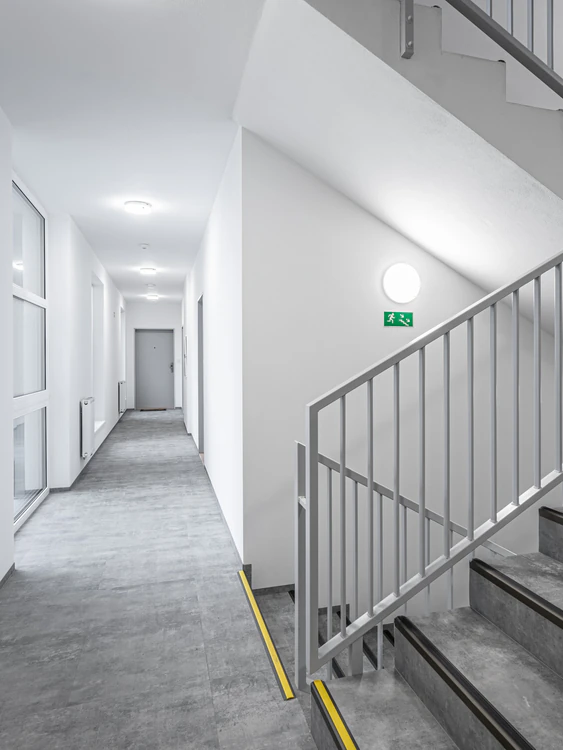
Emergency lighting systems we install
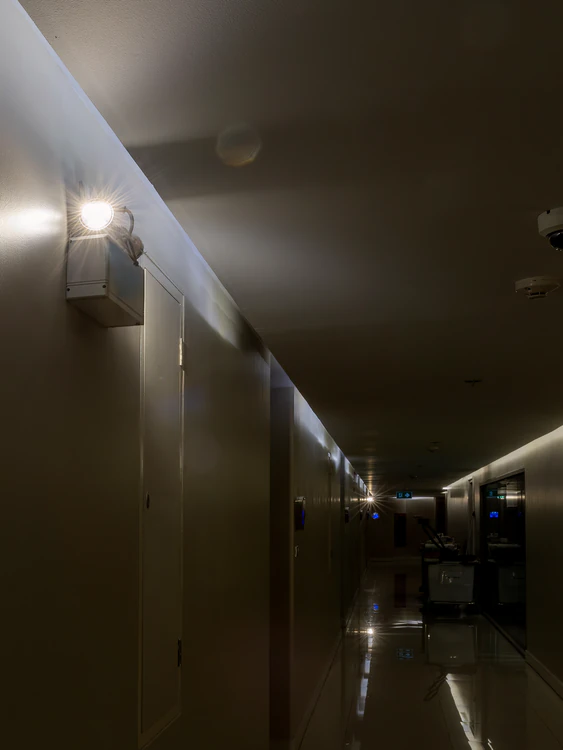
We design and install the full range of modern commercial emergency lighting:
- Self-contained LED emergency lighting – our recommended default for most commercial buildings. Each luminaire has its own battery, LED light source and self-test circuitry. Reliable, energy-efficient, low maintenance and long service life
- Central battery systems – one centralised battery bank supplying multiple luminaires. Used where centralised testing and longer-duration backup are required
- Addressable emergency lighting systems – networked systems with individual luminaire monitoring, self-test scheduling and integration with site BMS or fire alarm
- Static inverter solutions – where the building’s emergency lighting needs to run from the normal mains supply through an inverter rather than dedicated batteries
- Specialist emergency lighting – for high-risk environments, hazardous areas or complex buildings where standard solutions don’t fit
Most new installations we do are self-contained LED. The product technology has matured to the point where it outperforms central battery in reliability, ease of maintenance and total cost of ownership for the vast majority of commercial buildings. Where central battery or addressable is the right answer (typically large estates, complex testing logistics, or specific compliance requirements), we install that instead. Recommendation is always based on the building, not the kit we’d prefer to sell.
Design, install, commission and handover
Every emergency lighting project we deliver includes the following phases. The same engineers handle the project through every phase – no sub-contracted commissioning, no handoffs between design and install.
Design
Either working from an M&E consultant’s specification or providing a fully designed solution. Photometric calculations against BS EN 1838 lux requirements, luminaire selection, circuit design, control strategy.
Supply
Approved luminaires, batteries, controllers, switches and test equipment from our specified manufacturers.
Installation
Cable, containment, luminaires installed by our own engineers to BS 7671 and BS 5266.
Commissioning
First-fix and second-fix testing, full discharge test on completion, controller programming and integration with BMS / fire alarm where required.
Handover documentation pack
Emergency lighting design documentation, installation certificates, BS 5266 compliance certification, commissioning records, as-fitted drawings where required, asset registers and luminaire schedules, test results and inspection records, operation and maintenance manuals, recommendations for ongoing inspection and maintenance programmes.
Got questions? We've answered the common ones.
Quick answers on cover, callout times, accreditations and what working with us actually looks like. Still got a question? Get in touch.
Are you accredited?
Yes. WSD holds BAFE (SP203-1), NICEIC Approved Contractor and SafeContractor accreditations, and we are members of the FIA and BSI. Insurance: £5m public liability, £10m employers’ liability, £1m professional indemnity, £5m product liability. Certificates available on request.
What is the difference between maintained and non-maintained emergency lighting?
Non-maintained luminaires are dark during normal operation and only switch on when the normal lighting supply fails. Maintained luminaires are illuminated continuously. Non-maintained is the standard for most workplaces. Maintained is used where the lighting needs to be visible at all times, such as cinemas, theatres and places of assembly.
1-hour or 3-hour emergency lighting – which do I need?
3-hour is the standard for most non-domestic premises and what BS 5266-1 recommends as the default. 1-hour is acceptable for limited applications where the building is small, the evacuation route is simple and quick evacuation is guaranteed. When in doubt, 3-hour gives the safest compliance margin and the cost difference is marginal.
What is BS 5266?
BS 5266-1 is the British Standard code of practice for the emergency lighting of premises. It defines where emergency lighting is required, what duration it must operate for, and how it should be designed. It is complemented by BS EN 1838 (which specifies the minimum lux levels along escape routes) and BS EN 50172 (which specifies the system-level requirements including testing).
Self-contained LED or central battery – which is better?
For most modern commercial buildings, self-contained LED is our recommendation. Each luminaire has its own battery and LED light source, so reliability is high, maintenance is simple, and the technology has very long service life. Central battery still has a place in large estates, complex testing environments or buildings where centralised charge management is a real benefit, but it’s the exception rather than the rule now.
What does a BS 5266 compliance certificate cover?
The certificate confirms the system has been tested in accordance with BS 5266 and lists the test method, the pass/fail status of every luminaire, the battery condition, any luminaires that failed the discharge test, and any remedial work required.
What’s the difference between self-test and central-battery emergency lighting?
Self-test fittings each carry their own battery and run their own monthly test, reporting back centrally. Central-battery systems run all fittings from a single battery cabinet — simpler maintenance but a single point of failure. We install both, depending on the building.
How often does emergency lighting need to be tested?
Two tests are required under BS 5266 and BS EN 50172: a monthly functional test (a short “flick test” that confirms every luminaire activates when the mains drops out) and an annual full-duration discharge test (every luminaire tested for its full rated duration, typically 3 hours). The monthly test can be done by site staff with a test key. We typically handle the annual test as part of a maintenance contract.
Do you cover the whole UK?
Yes, we deliver maintenance contracts and projects nationally from our Bromsgrove HQ. Most of mainland Britain is within a routine response window for reactive maintenance work.
Sites further from the Midlands may have slightly longer response windows for reactive call-outs; we can provide a map of typical response times by area during the initial survey if it’s relevant to your site.
Can you take over an existing system installed by someone else?
Yes. We routinely take over the maintenance of systems originally installed by someone else.
We carry out an initial survey and full functional test of the existing system first, give you a written baseline of what’s there and what condition it’s in, then quote against bringing it onto an ongoing maintenance contract. The survey is quoted separately to the contract, so there’s no commitment until you’ve seen the findings.
Detail that often comes up.
Standards, integration, manufacturers and the questions we get asked most. Skim or dive in.
- BS 5266
- Duration
- Luminaire types
- Testing
- Manufacturers
- Sectors
- Takeovers
- Standards
BS 5266
UK emergency lighting compliance sits across three main standards. We work to all of them:
- BS 5266-1 – Code of practice for the emergency lighting of premises. The headline standard that defines where emergency lighting is required, what duration it must operate for, and how it should be designed.
- BS EN 1838 – Lighting applications: emergency lighting. Specifies the minimum lux levels along escape routes, at change-of-direction points, at exits and in open areas.
- BS EN 50172 – Emergency escape lighting systems. Specifies the system-level requirements including testing regimes, logging and record-keeping.
Where the building has specific high-risk features, additional standards may apply. We’ll flag that during design.
Talk to our team
We will walk through your project, scope the work, and quote against what you need.
Duration
The two most common emergency lighting durations are 1-hour and 3-hour. The right duration depends on the building:
- 3-hour systems are the standard for most non-domestic premises. They allow enough operating time for both safe evacuation and any post-evacuation fire-service activity. BS 5266-1 recommends 3-hour as the default for most occupied buildings.
- 1-hour systems are acceptable for limited applications, typically smaller buildings with simple evacuation routes and a guaranteed quick evacuation. Less commonly specified in modern practice.
When in doubt, we design to 3-hour. The cost difference is marginal and the compliance margin is wider.
Talk to our team
We will walk through your project, scope the work, and quote against what you need.
Luminaire types
A second design choice on emergency lighting is whether the luminaires run continuously (maintained) or only switch on during a mains failure (non-maintained):
- Non-maintained – the luminaire is dark during normal operation and switches on only when the normal lighting supply fails. The standard choice for most workplaces where occupants are familiar with the building and the lighting only needs to illuminate escape routes during a power loss.
- Maintained – the luminaire is illuminated all the time, both during normal operation and during a mains failure. Used where the lighting needs to be visible at all times, typically in cinemas, theatres, places of assembly, and any location where occupants may not be familiar with the building layout.
Many modern luminaires can be wired as either, so the design choice is about strategy more than product.
Talk to our team
We will walk through your project, scope the work, and quote against what you need.
Testing
Once installed, emergency lighting needs a defined testing regime to remain compliant with BS 5266 and BS EN 50172. Two tests matter most:
- Monthly functional test (the “flick test”). A short test that simulates a mains failure to verify every luminaire activates correctly. Takes a few seconds per luminaire. Can be done by site staff using a test key, or by WSD as part of a contract.
- Annual full-duration discharge test. Every luminaire is tested for its full rated duration (typically 3 hours) to confirm the battery holds charge for the design period. This is the test that catches degraded batteries before they fail in an emergency. We handle this as part of maintenance contracts.
Both tests must be logged in your emergency lighting log book (and our digital reporting platform will keep a permanent record automatically).
We issue full BS 5266 compliance certification with each annual test, covering test method and pass/fail status for every luminaire, battery condition and replacement recommendations, any luminaires failing the discharge test, and remedial work required and proposed timescale.
Talk to our team
We will walk through your project, scope the work, and quote against what you need.
Manufacturers
We install systems from the leading UK and European emergency lighting manufacturers. Plus any other approved system where the project requires it. Selection is driven by the design specification, the M&E consultant’s brief if there is one, building infrastructure for retrofits, and the client’s long-term maintenance strategy. As with all our work, we install what fits the project rather than pushing what suits us.
Advanced
Mackwell
Eaton
Zumtobel
Thorlux
LuxIntelligent
Ansell Lighting
Clevertronics
Emergi-Lite
Chubb
Talk to our team
We will walk through your project, scope the work, and quote against what you need.
Sectors
WSD installs emergency lighting across the full range of UK commercial and public-sector environments. Each sector has its own emergency lighting design considerations. Hotels have sleeping risk that drives extended-duration requirements. Warehouses have height and aisle-spacing considerations. Schools have occupancy patterns that affect maintenance scheduling. Healthcare has additional regulatory layers. We design for the sector, not from a template.
Schools and educational facilities
Commercial offices
Residential apartment blocks
Healthcare facilities and care homes
Retail developments
Hotels and leisure facilities
Industrial and manufacturing facilities
Warehouses and logistics centres
Public buildings
Student accommodation
Infrastructure and utility sites
Talk to our team
We will walk through your project, scope the work, and quote against what you need.
Takeovers
For existing buildings with installed emergency lighting, we start with an initial survey and a full functional and discharge test of the existing system. That gives you a written baseline of what’s there, what’s working, what’s failed and what needs replacing.
From there you can take any of three routes:
- Remedial works only, then handing the system back to your existing maintenance provider
- Remedial works followed by an ongoing WSD maintenance contract
- Full refurbishment or replacement where the existing system is too far gone
We don’t insist on any particular route. The survey gives you the information to make the right call.
Talk to our team
We will walk through your project, scope the work, and quote against what you need.
Standards
WSD’s emergency lighting work is delivered to current British and European standards:
BS 5266-1
Code of practice for emergency lighting of premises
BS EN 1838
Lighting applications: emergency lighting
BS EN 50172
Emergency escape lighting systems
BS 7671
IET wiring regulations
BS 8519
Fire-resistant cable systems, where applicable
Talk to our team
We will walk through your project, scope the work, and quote against what you need.
Assured, insured & compliant.
WSD holds the accreditations the industry treats as the minimum bar for serious commercial work. Backed by £5m public liability, £10m employers liability, £1m professional indemnity and £5m product liability cover. All work delivered to current British Standards.


Need emergency lighting designed, installed, tested or taken over?
New build, retrofit, takeover, or just a survey to understand what you’ve got – we’ll quote against what your building actually needs.